Blog #1
BLOG #1
My experience with disabilities:
I grew up knowing a few people with disabilities at school and in my own family. A boy named Aiden in my kindergarten class had a prosthetic leg. I never knew until gym class (he always wore pants) because I remember him having to sit out if we were doing something that involved running.
I remember learning what dyslexia was in Mrs. Jackson's 6th grade english class because my friend Sam had it.
My Grandpop had limited hearing and he was able to lip read.
I took a class my freshman year called "disabilities and dignity" and I learned a lot from that class. I have a feeling we're going to be covering similar topics in this class that we went over in the class I had when I was freshman! I'm really looking forward to this semester!
"Inspiration porn"
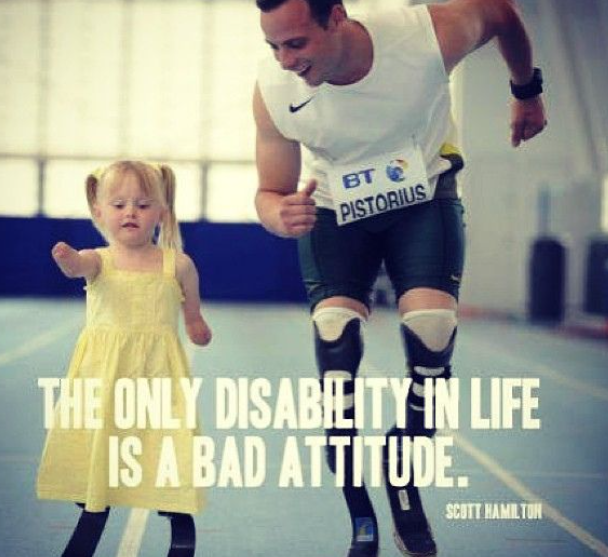 |
The image above is an example of people with disabilities being used as "inspiration porn." My honest, initial reaction to this is that I'm guilty of seeing images like this and thinking that it was inspiring. I'm thankful that this week's lesson enlightened me and helped me understand how people with disabilities feel about being used as "inspiration porn" and that it isn't right.
Another example of inspiration porn:
 |
"I'm not your inspiration, thank you very much"
Stella Younger's TED Talk's really opened my eyes. It informed me what "inspiration porn" is and how people with disabilities are used in them and how she feels about it. She states in the TED Talk: "We are learning from each other's strength and endurance, not against our bodies and our diagnoses, but against a world that exceptionalizes and objectifies us.” "Inspiration porn" is just one way people with disabilities are objectified. She ends her TED Talk with a powerful statement: “Disability doesn't make you exceptional, but questioning what you think you know about it does."
15% of the world have some form of disability - that's 1 billion people!
A promotional video with the hashtag #WeThe15 for the 2021 summer Paralympic games shows athletes who don't like being used as "inspiration porn" when 15% of the world has some form of a disability (hence the 15 in #WeThe15). The end of the video states: “Only when you see us as one of you only then can we break down these barriers that keep us apart.”
"I’m not 'brave' for having a disability: it’s not a choice."
Jessica Kellgren-Fozard wrote an article in 2018 titled "Why not all disabled people want to be seen as an inspiration." She talks about how her disability makes living life more difficult and it's nice to have people cheering her on, but how she doesn't like how she's objectified and how random people think it's okay to come up to her and ask "what happened?" when they see her using her crutches or wheelchair. She finds it unethical that people with disabilities are used in "inspiration porn." Sammi Kinghorn, a Scottish World Champion wheelchair racer, says in the article that: "We’re beginning to be seen as superhuman people overcoming great adversity, [but] to me we’re just people."
1 in 4 adults with disabilities 18 to 44 years have an unmet health care need because of cost in the past year
41.6 percent of adults with a disability are obese while 29.6 percent of adults without a disability are obese.
21.9 percent of adults with a disability smoke while 10.9 percent of adults without a disability smoke.
The broader social issues of disability within society and their impact on sports participation Chapter 5 of "The Paralympic Games Explained" by Ian Brittain
Thanks for reading!
Comments
Post a Comment